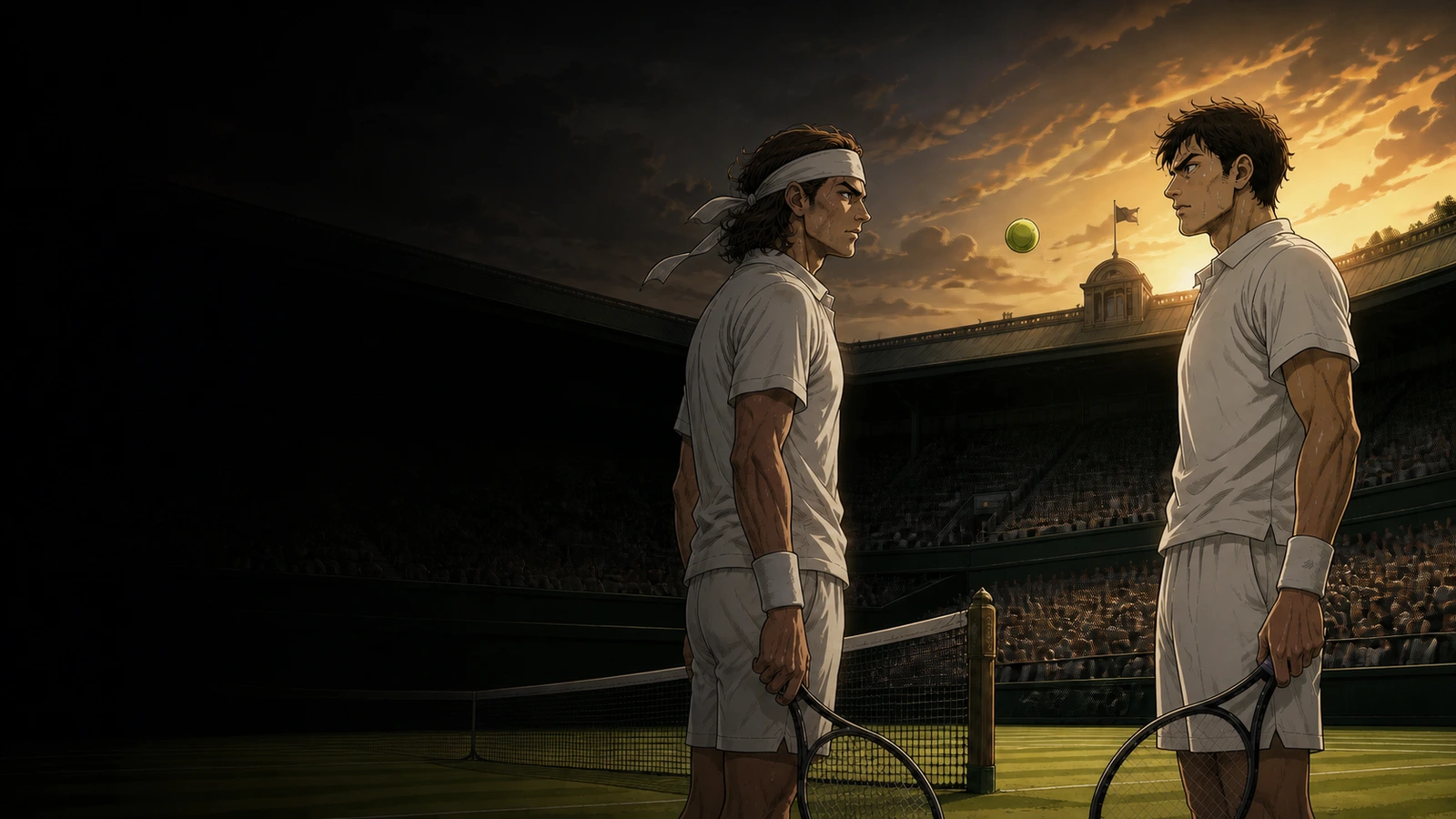
THE TENNIS MATCH THAT REFUSED TO END
Rafael Nadal had already stood one point from winning Wimbledon. Roger Federer saved himself. Then he did it again.
Hours later, Nadal prepared to serve for the championship once more. Rain had interrupted them, daylight was disappearing over Centre Court and the deciding set had moved beyond the point where an ordinary tie-break could rescue either player. The question was no longer only who could strike the ball better. It was whether Nadal could release the memory of the endings Federer had taken away from him.
The final would last four hours and forty-eight minutes of playing time. Its scoreline matters, but revealing every number now would hide what made the match extraordinary: it repeatedly reached a plausible ending and then opened another door.
Federer entered the 2008 final as the ruler of Wimbledon's grass. He had won five consecutive titles and was attempting to pass Björn Borg's modern-era run of five in a row. His movement, serve and ability to take the ball early seemed designed for Centre Court. He had not lost a set during the tournament.
Nadal arrived as the greatest clay-court player of his generation, but the old description of him as only a clay specialist was already collapsing. He had reached the Wimbledon final in 2006 and 2007, losing both times to Federer. A few weeks before the 2008 final, he had beaten Federer heavily in the French Open final. Paris proved Nadal's dominance on clay. London would test whether his game had expanded far enough to defeat Federer on Federer's strongest stage.
Their rivalry made the surface feel like territory. Federer represented elegant first-strike tennis and an uninterrupted grass-court reign. Nadal brought topspin, physical pressure and a left-handed forehand that climbed into Federer's one-handed backhand. But reducing them to style types misses their adaptability. Federer could defend and improvise. Nadal could attack, volley and serve with precision. The final became great because neither man was trapped inside the role assigned to him.
Rain delayed the start. When play began, Nadal looked less burdened by the occasion. He broke Federer's serve in the first set and protected the advantage to take it 6–4. Federer created opportunities, but Nadal defended break points with the stubbornness that had defined their matches on clay.
The second set deepened the threat. Federer moved ahead early, but Nadal recovered, attacked the backhand and won another 6–4 set. The five-time champion was now two sets down on Centre Court.
That score suggested a straightforward upset. The tennis did not. Federer was still serving well enough to shorten points. Nadal was still being forced to absorb attacks. Small changes in return position or first-serve percentage could alter an entire set. And a best-of-five final gives a champion time to rebuild himself.
The third set stretched into a tie-break. Federer played it with the authority of someone who understood that the match could not be recovered all at once. He did not need to solve Nadal forever. He needed seven points before Nadal did. Federer won the breaker 7–5 and reduced the deficit.
Then rain returned.
The interruption increased the tension because it offered both players time to imagine the remaining possibilities. Nadal was still ahead. Federer had finally taken a set. Centre Court waited under a darkening sky while the clean rhythm of competition was replaced by uncertainty.
When they resumed, the fourth set became the match's emotional centre. Neither player could break. Federer protected his serve with placement and nerve. Nadal kept dragging him into rallies that required one more low volley, one more backhand, one more change of direction. The set reached another tie-break.
Nadal moved to championship point. Federer erased it. Nadal created another. Federer answered with a backhand passing shot down the line, one of those strokes that appears reckless until it lands inside the court. Federer eventually won the tie-break 10–8.
The second save changed more than the score. Nadal had followed the ball forward, trying to finish at the net. Federer was stretched wide, close to the edge of the court and one mistake from defeat. He drove the pass through the narrowest available line. It was not a safe shot chosen to extend the rally. It was an answer that had to be perfect immediately.
For Nadal, the danger was psychological as well as tactical. A player can recover from losing a set; recovering from seeing the championship within reach is different. During the changeover he had to carry two missed endings into a fifth set against a champion whose confidence had just been restored. Federer, meanwhile, could not celebrate survival for long. The next set began at love-all, with none of his previous resistance stored on the scoreboard.
Two championship points had disappeared. Two sets all.
The structure of the final had reversed. Nadal had been one point from victory and now faced a fifth set against the most successful Wimbledon player of the era. Federer had been two sets down and now seemed to possess the momentum. Yet momentum in tennis is fragile because every set restarts the score at zero.
The deciding set had no tie-break under the rules then used at Wimbledon. One player had to lead by two games. That detail changed the atmosphere. There was no fixed final point waiting at 6–6. The match could continue as long as both men held serve.
They reached 2–2, then rain stopped them again. The pause pushed the contest later into the evening. When they returned, the light had begun to fade. Centre Court did not yet have the roof that would transform future championships. The players were racing not only each other but visibility.
Nadal earned a break point in the eighth game. Federer saved it. Federer came within points of pressure on Nadal's serve. Nadal escaped. The games accumulated: 5–5, 6–6, 7–7.
By then, technical excellence had become inseparable from fatigue. Each player had to preserve his legs during service games while remaining ready for a sudden opening. Federer relied on the serve to create shorter exchanges. Nadal continued forcing the champion to play balls from uncomfortable heights and positions. Neither man could afford a sequence of ordinary errors.
At 7–7, Nadal finally broke. The opportunity did not arrive as a grand announcement. It emerged from pressure applied over hours. Federer missed, Nadal moved ahead, and suddenly the challenger would serve for the title again.
This was not the same situation as the fourth-set tie-break. Nadal had already stood one point from victory and watched Federer escape. Now every memory of those saved championship points could have tightened his arm.
Federer fought to stay alive. On the final rally, he drove a forehand into the net. Nadal fell backwards onto the grass.
The service game forced Nadal to confront the exact pressure that had stopped him earlier. Federer kept the return game alive and made every pause feel longer. Nadal could not ask the fading light to save him or the clock to declare a winner. He still had to begin the final rally, move Federer from side to side and wait for the error that had refused to arrive during the fourth-set tie-break.
The clock read 9:16 p.m.
Nadal had won his first Wimbledon title, his fifth major singles championship and the match that completed his transformation from clay-court master into an all-surface champion. Federer had lost at Wimbledon for the first time since 2002, but the defeat did not diminish the standard he produced to extend the final. Without his resistance, the match is remembered as a strong four-set win. Because he kept answering, it became an epic.
The official playing time was four hours and forty-eight minutes. Rain made the day much longer than that. At the time it was the longest men's singles final in Wimbledon history, though the 2019 final between Novak Djokovic and Federer later surpassed it. It was not the longest tennis match ever, and accuracy matters because the drama does not need inflation.
What made the 2008 final exceptional was not duration alone. Long matches can become repetitive. This one kept changing its meaning.
At two sets to love, it was Nadal's breakthrough. After the third-set tie-break, it was Federer's recovery. At championship point in the fourth, it was nearly over. After Federer's backhand pass, it became a fifth-set test. When rain returned, the contest became a race against darkness. At 7–7, it was balanced again. One break later, Nadal stood where he had been hours earlier, serving for history.
The match also marked a transfer of authority without ending the rivalry. Nadal would rise to world number one later that summer. Federer would return to win Wimbledon again in 2009. Their careers continued to overlap, producing more finals and more revisions to the argument about who was greater. But on 6 July 2008, the balance shifted visibly.
Federer's reign had made victory on Centre Court look orderly. Nadal's challenge made it look physical, uncertain and unfinished. He did not take the title by overwhelming Federer quickly. He had to defeat the champion, survive the champion's recovery and then defeat the possibility that his own missed chances would define him.
That is the hidden burden of a match that refuses to end. The player who was closer to victory must repeatedly release the disappointment of not finishing. The player who was closer to defeat must repeatedly create belief without assuming the danger has passed.
Federer performed that act through two tie-breaks and multiple championship points. Nadal performed it after losing both of those tie-breaks. Their mental strength did not look identical. Federer's appeared in clean serves and sudden attacking shots when the margin vanished. Nadal's appeared in his willingness to begin the next rally as though the previous escape had not wounded him.
The final point looked simple compared with what came before it: Federer's forehand met the net. But the net was only where four hours and forty-eight minutes finally became visible.
Nadal lay on the grass. Federer waited across the court. The light had almost gone. There would be no third rain delay, no third tie-break, no further recovery.
For an entire afternoon and evening, every ending had opened another door. Two sets became three. Championship points became a fifth set. Six-all became seven-all. Then, at 9–7, the match finally accepted an ending.
Rafael Nadal was Wimbledon champion. Roger Federer was no longer unbeaten on Centre Court. And tennis had produced a final remembered not because it lasted forever, but because for so long, neither man allowed the other to finish it.
The official score finally read 6–4, 6–4, 6–7, 6–7, 9–7. It looks orderly on a page. On Centre Court, each new number had represented another ending that failed to hold.