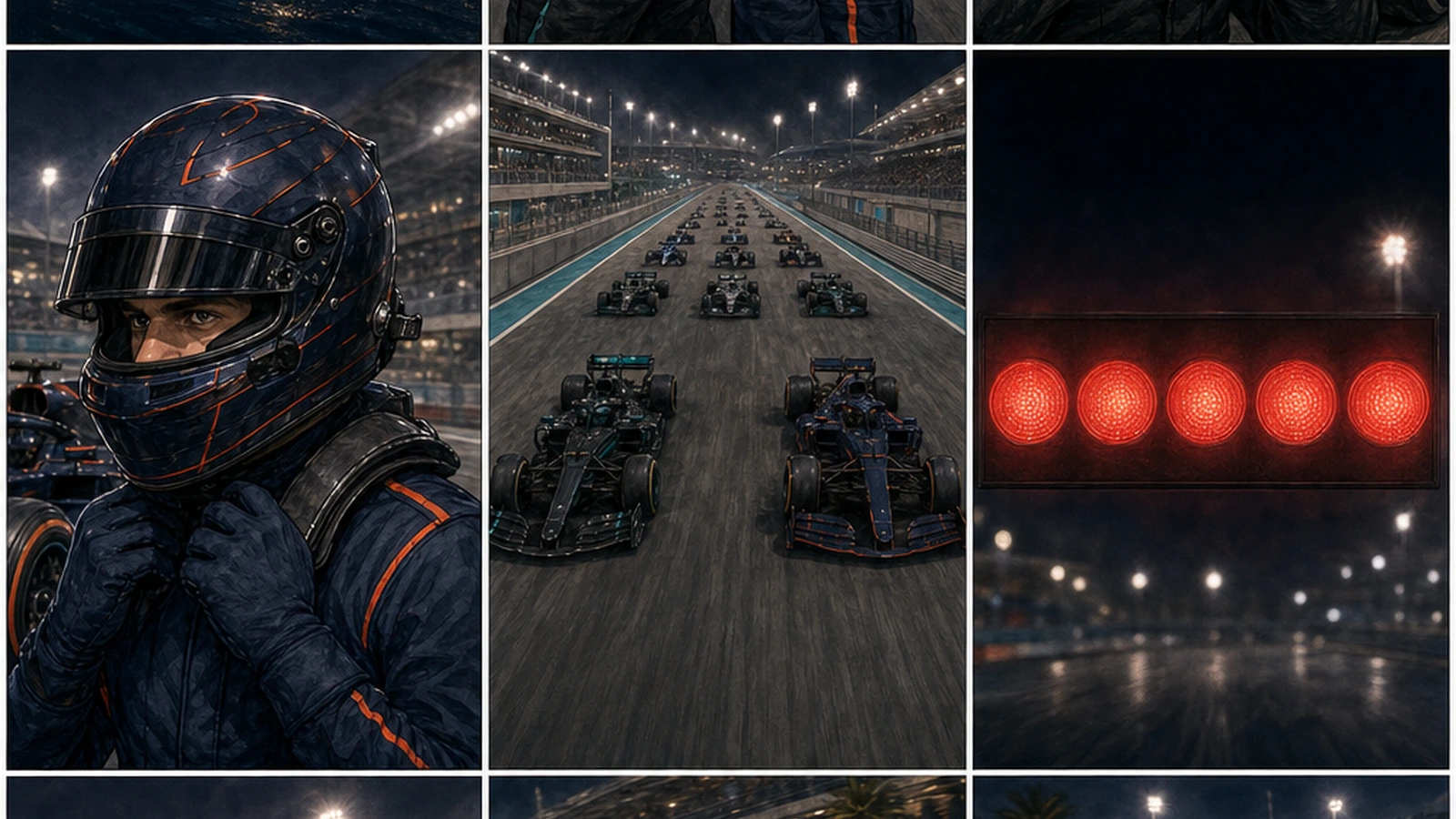
THE LAST LAP THAT SPLIT FORMULA ONE
Five laps remained. Lewis Hamilton led the race and, with it, the world championship. Max Verstappen was second, but five lapped cars sat between them. Then race control moved those five cars, restarted the race for one final lap and placed Verstappen's fresh soft tyres directly behind Hamilton's old hard tyres.
Verstappen attacked at turn five. Hamilton tried to answer. When the chequered flag fell, Verstappen was officially race winner and world champion, with Hamilton 2.256 seconds behind.
But the question that split Formula One was not whether the flag fell. It was how the two title rivals had been placed together before it did. Why were only the cars between them moved? Why did the safety car come in immediately? And what did the FIA mean when its own review later found that the full procedure had not been followed?
The answer requires slowing down the final six laps without turning either driver into the author of race control's decisions.
Hamilton and Verstappen arrived at Yas Marina level on points after twenty-one rounds. The rivalry had already contained collisions, penalties, disputed judgement calls and races decided by tiny margins. The final equation looked unusually simple. Whichever contender finished ahead, assuming both scored in the ordinary way, would take the championship.
Verstappen started from pole position. Hamilton started beside him. But when the lights went out, Hamilton launched better and took the lead. There was an argument on the opening lap when Verstappen attacked and Hamilton went off the circuit before rejoining ahead. The stewards did not order a position change. That moment mattered to both camps, but it did not decide the race. Over the long middle section, Hamilton was faster.
Mercedes had built its strategy around track position. Red Bull tried to create opportunities. Sergio Perez, Verstappen's teammate, delayed Hamilton with a fierce defence after his own pit stop cycle. The delay reduced Hamilton's advantage and gave Verstappen time, but Hamilton pulled away again. By the closing stages, he was leading on hard tyres that had completed a long stint. Verstappen was behind and needed something dramatic.
On lap fifty-three of fifty-eight, Latifi crashed his Williams at turn fourteen. Debris and a damaged car made a safety car necessary. In a normal race, that neutralisation compresses the field. Cars may pit, but a pit stop costs track position. The leader must choose without knowing exactly how long the cleanup will take.
Verstappen stopped for fresh soft tyres. He could do so without losing second place because the gap behind him was large enough. Hamilton stayed out. Mercedes judged that pitting might surrender the lead and that there might not be enough racing laps left to recover it. Hamilton therefore remained first on old hard tyres. Verstappen remained second on new soft tyres, but several lapped cars sat between them in the queue behind the safety car.
That difference was crucial. If the race ended behind the safety car, Hamilton would win. If racing resumed with the lapped cars still in place, Verstappen would first have to pass them. If all lapped cars were allowed to unlap themselves and the safety car completed the procedure described in the regulations, time might run out before a green-flag lap. Every option carried consequences, but the written process was supposed to determine which consequences were legitimate.
This is where several truths collide. Verstappen had driven a championship season worthy of the title. Hamilton had controlled the decisive race. Latifi's crash was a normal sporting accident with enormous consequences. Race control faced limited time and enormous pressure. None of those facts answers the procedural question that was about to define the ending.
Race control initially sent the message that lapped cars would not be allowed to overtake. That suggested the cars would remain where they were. Then, late in the process, the instruction changed. Five lapped cars positioned between Hamilton and Verstappen were told to pass the safety car. Other lapped cars were not given the same instruction.
Verstappen was now directly behind Hamilton.
The championship had changed before either contender touched the accelerator.
At almost the same time, race control announced that the safety car would come in at the end of the lap. That created one final lap of racing. The championship contenders were nose to tail, but they were not on equal equipment. Hamilton's hard tyres had carried him through much of the race. Verstappen's soft tyres were fresh and designed to provide much more grip over a short sprint.
The safety car turned into the pit lane. Hamilton controlled the pace until the restart line. Verstappen stayed close, moved into the slipstream and attacked at turn five. He went down the inside and took the lead. Hamilton did not simply disappear. He fought back along the following straight and drew close again, but Verstappen defended through the next sequence. One lap was enough.
When Verstappen reached the finish, Red Bull erupted. Hamilton sat in his car for a long time before speaking. The grandstands had witnessed an ending almost too concentrated for the season that produced it: two drivers, one lap, one title.
But sport is not only the spectacle that happens on the track. It is also the agreed system that makes the spectacle legible. Mercedes protested the result. One protest concerned whether Verstappen had briefly drawn ahead while both cars were still behind the safety car. Another concerned the handling of the unlapping procedure and the timing of the restart. The stewards dismissed both protests.
Mercedes then gave notice that it intended to appeal. Four days later, the team withdrew that intention after the FIA announced a detailed review. That withdrawal ended the sporting route that might have continued the case. Verstappen's championship was confirmed at the FIA prize-giving.
The story did not end there, because the governing body still had to explain what had happened.
In March 2022, the FIA published its report to the World Motor Sport Council. The report did not erase Verstappen's title. It did not declare Hamilton champion. It did, however, acknowledge serious problems in the process.
The review found that the race director had called the safety car back into the pits without completing an additional lap as the relevant regulation had been understood to require. It found that not all lapped cars were permitted to unlap themselves. It described the different interpretations of the rules and concluded that human error had contributed to the fact that the full procedure was not followed.
The report also said the race director acted in good faith and to the best of his knowledge. That distinction matters. A flawed decision is not automatically evidence of a conspiracy. The review pointed to wider conditions: pressure to finish races under green-flag conditions, direct communications from teams to the race director and the intense operational load carried by one person in a rapidly changing situation.
Those team communications became part of the controversy because viewers heard senior figures arguing their preferred outcomes over the radio. Red Bull wanted racing to resume. Mercedes wanted the established procedure respected in a way that protected the order Hamilton had earned. Both teams were pursuing their competitive interests. The official had to make the decision.
After Abu Dhabi, Formula One changed that structure. Direct radio access from teams to the race director was restricted. A remote operations centre was introduced to support race control. The role itself was reorganised. The disputed wording around lapped cars was clarified for the following season.
Those changes do not tell us which driver “deserved” the championship. Deserving is a judgement spread across an entire season. Verstappen won ten races in 2021 and delivered performances of speed and resilience. Hamilton won eight and produced a remarkable late-season recovery to arrive level on points. Both survived moments when their title challenge could have ended. Both benefited from some decisions and suffered from others.
Nor can anyone prove the result of every alternative ending. If the race had finished behind the safety car, Hamilton would have won that day under neutralised conditions. If the red flag had been shown, both drivers might have restarted on fresh tyres, but the rules did not require a red flag merely to create a spectacle. If the lapped cars had remained in place, traffic would have changed Verstappen's task. If the full unlapping sequence had been completed, there might have been no racing lap left. Counterfactuals can explain stakes, but they are not events that actually happened.
What happened was specific. A late crash triggered a safety car. One contender changed tyres and the other protected track position. Race control changed its instruction, moved only the cars separating the title rivals and restarted the race for one lap. Verstappen used the opportunity exactly as a racing driver should. Hamilton defended with what he had. The FIA later found that the procedure was not fully followed, while the official classification remained unchanged.
That is why the finale still resists a simple ending. For Verstappen's supporters, the last lap is the moment a season of relentless pressure became a first world title. For Hamilton's supporters, it is the moment an earned race lead was exposed by a process the governing body later admitted was flawed. For the FIA, it became a case study in how rules, communication and decision-making can fail under the greatest pressure.
The most useful lesson is not that sport should eliminate uncertainty. Formula One is built on uncertainty: weather, mechanical failure, strategy, traffic and safety cars. The lesson is that when uncertainty arrives, the rules must be dependable enough that the drama belongs to the competitors.
Abu Dhabi produced one of the most watched and discussed laps in Formula One history. It gave the championship a spectacular image: Verstappen attacking, Hamilton trying to answer, the title changing hands in a matter of corners. But the lasting power of that image comes from the question behind it.
Was the final lap a perfect sporting climax, or was it a climax manufactured by a procedure that should not have been used that way?
The official record answers who won. Max Verstappen won the race and the 2021 world championship. The FIA review answers part of how the restart was created: the safety-car process was not applied in full, human error contributed, and reforms followed.
Those answers can coexist. They have to, because removing either one turns history into advocacy.
One lap did not create the entire championship. It did not erase the twenty-one races that came before it, the skill of the new champion or the performance of the driver who lost. But it concentrated a season's rivalry and a sport's governance into five kilometres of asphalt.
Verstappen took the chance he was given. Hamilton lost a lead he had built. Race control made decisions the FIA later examined and changed its systems to prevent from recurring in the same way.
The chequered flag ended the race. It never ended the argument. And that is why the last lap at Abu Dhabi did more than decide Formula One's world champion. It split the sport over what a fair ending is supposed to look like.