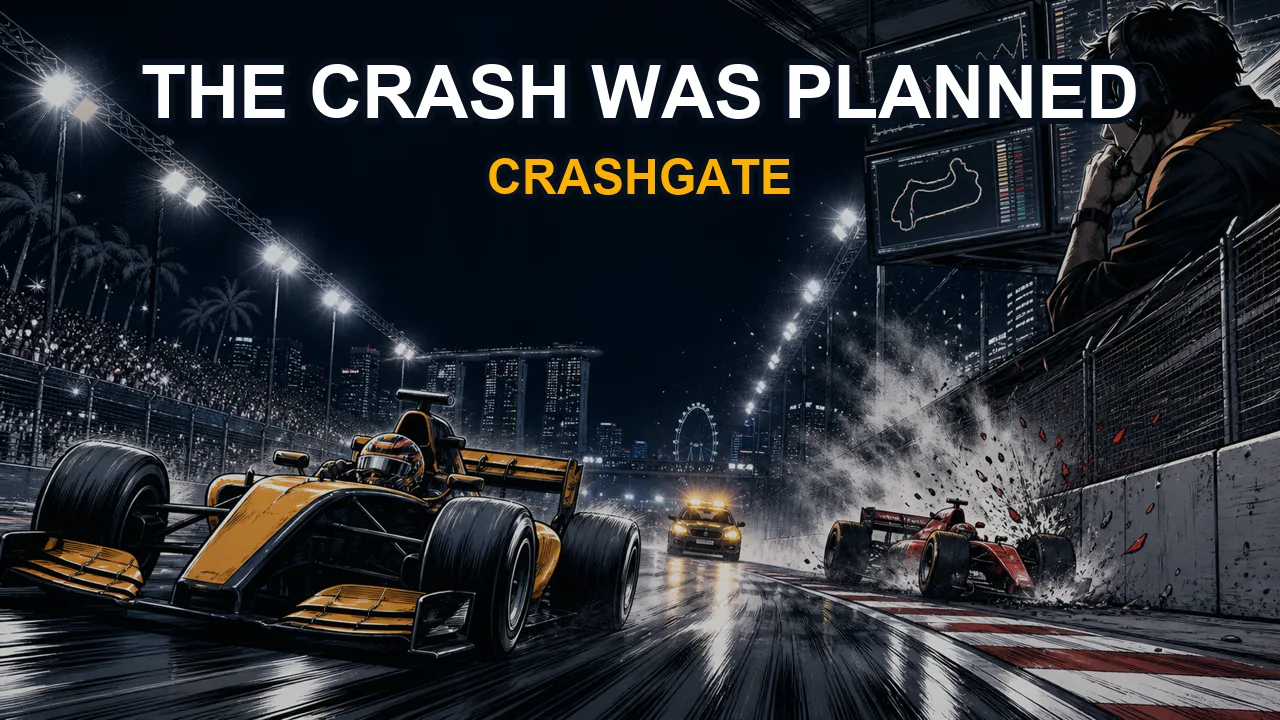
Nelson Piquet Junior hit the wall at Turn Seventeen on lap thirteen of the 2008 Singapore Grand Prix.
At first, it looked like a costly driver error in a demanding street race. The crash brought out the safety car. Fernando Alonso, Piquet’s Renault teammate, had made an unusually early pit stop and suddenly found himself on a strategy that could win. He did.
Nearly one year later, the apparent coincidence was exposed as something calculated. Renault admitted that senior team figures had conspired with Piquet to cause the crash deliberately.
Formula One had seen technical cheating, team orders and political battles. Singapore crossed another line. A team had turned an accident into a strategic tool on a live circuit, placing sporting integrity and physical safety beneath the pursuit of one result.
The scandal became known as Crashgate.
Formula One under the lights
The 2008 Singapore Grand Prix was already historic. It was Formula One’s first night race, held on a street circuit under thousands of lights. The visual spectacle suited a championship becoming increasingly global.
The track was tight, bumpy and bordered by concrete. Heat and humidity tested drivers. A small mistake could end a race because there was little run-off area.
Ferrari’s Felipe Massa started from pole position. He was fighting Lewis Hamilton for the world championship. Alonso qualified only fifteenth for Renault after a fuel-system problem interrupted his session. From that position, victory appeared extremely unlikely.
Renault chose an aggressive strategy. Alonso pitted early on lap twelve, before most of the field. Under the refuelling regulations of the time, stopping so soon would normally leave him trapped behind traffic and carrying a strategy few rivals needed to copy.
One lap later, Piquet crashed.
The timing changed everything.
Why the safety car mattered
Formula One’s rules around pit stops and the safety car were different in 2008. When the safety car appeared, the pit lane initially closed. Drivers who needed fuel could be forced either to wait or to stop and accept a penalty. The field also compressed behind the safety car, removing gaps built during racing.
Alonso had already stopped. He did not need to enter the closed pit lane. As rivals completed their stops or served penalties, he moved into a strong position.
The restart brought further chaos. Massa’s Ferrari pit stop failed disastrously when he was released with the fuel hose still attached. He lost time and eventually finished outside the points. Other drivers’ strategies were disrupted.
Alonso drove well from the position the safety car had created. He took the lead and won the race, delivering Renault’s first victory since 2006.
At the time, the result could be explained as fortune meeting bold strategy. Street circuits regularly produce safety cars. A driver starting near the back can benefit from stopping at exactly the right moment. Piquet was a struggling rookie who had crashed before.
The story was surprising, not yet scandalous.
The truth emerges
Piquet lost his Renault seat during the 2009 season. After his departure, he told the FIA that he had been instructed to crash intentionally in Singapore.
According to the investigation, Renault team principal Flavio Briatore and executive director of engineering Pat Symonds were involved in the plan. Piquet was told where and when to crash so that the safety car would appear after Alonso’s early stop.
The location mattered. Turn Seventeen was selected because removing a damaged car there would be difficult, making a safety-car deployment likely.
Renault initially challenged the accusations but later announced it would not dispute them. Briatore and Symonds left the team. The World Motor Sport Council considered the case in September 2009.
Renault received a disqualification from Formula One suspended for two years. The team would be excluded if it committed a comparable offence during that period. Briatore received an indefinite ban from FIA-sanctioned events, while Symonds received a five-year ban. Those individual sanctions were later overturned by a French court, and settlements subsequently governed their return to motorsport.
Piquet received immunity from punishment in exchange for giving evidence. That decision was controversial because he had physically carried out the crash. Investigators considered his testimony necessary to expose the scheme.
Alonso was found not to have known about the plan. The unusual strategy benefited him, but official accounts did not establish that he participated in the conspiracy.
A crash is not an ordinary instruction
Formula One teams routinely control strategy. They tell drivers when to pit, which engine mode to use and whether to hold position. Team orders can be unpopular, but they operate within a structure where both cars serve a collective result.
Ordering a crash is fundamentally different.
A car hitting a concrete barrier does not create a controlled event simply because the driver chooses the location. Debris can scatter. Fire can start. Marshals may enter the circuit. Another car can arrive at speed. The driver can suffer injury beyond what engineers predict.
Piquet walked away, and no other person was hurt. That fortunate outcome should not be mistaken for safety.
The plan also manipulated every competitor. Teams made decisions based on the belief that the crash was accidental. Race control deployed the safety car to protect people at what it believed was a genuine incident. The conspiracy used a safety procedure as a performance device.
That is why Crashgate was not merely cheating in pursuit of speed. It corrupted the system designed to respond when speed goes wrong.
Piquet’s responsibility
Piquet’s position was complicated. He was a young driver trying to preserve his career under powerful management. Briatore was both his team principal and closely involved in his professional representation. Refusing an instruction could have felt like refusing the people controlling his future.
That imbalance helps explain why he agreed. It does not remove his agency. Piquet steered the car into the wall and remained silent for months. His later evidence exposed the plot, but it came after Renault had dismissed him.
The immunity agreement produced an uncomfortable trade-off. Punishing Piquet might have satisfied a sense of equal responsibility. It might also have discouraged future insiders from revealing wrongdoing that senior leaders could otherwise deny.
Whistleblowing often arrives from compromised people. They possess evidence precisely because they were involved. Sport must decide whether uncovering the larger truth is worth reducing their punishment.
Crashgate offers no perfectly clean answer. Piquet was pressured and participated. He later exposed the plan and benefited from immunity. All of those facts belong in the story.
The championship question
The 2008 championship ended with Hamilton beating Massa by one point. Because Massa had started from pole in Singapore and scored nothing after the chaotic pit stop, the scandal later became attached to the title debate.
It is understandable to ask what would have happened without Piquet’s crash. It is not possible to produce a certain answer. A race without that safety car would have unfolded differently for every driver. Pit stops, tyre performance, later incidents and strategic choices would all have changed.
Massa’s failed stop occurred during the safety-car sequence, but Ferrari still controlled the equipment and release. Alonso’s victory was shaped by the crash, yet rewriting the entire finishing order requires assumptions.
The strongest factual conclusion is that the conspiracy materially altered the Singapore Grand Prix during a championship decided by one point. Saying it definitively transferred the world title goes beyond what the evidence can prove.
This distinction matters because sporting scandals attract simple counterfactuals. The misconduct was serious enough without pretending history can be recalculated like a spreadsheet.
Why Renault would take the risk
Renault had won championships with Alonso in 2005 and 2006. By 2008, the team was no longer leading Formula One. Alonso had returned after a difficult season at McLaren, and pressure for a major result was high.
Singapore presented a promotional opportunity: a glamorous new race, global attention and a chance to show Renault could still win. Alonso’s qualifying problem appeared to remove that chance.
The conspiracy manufactured another one.
This is the dangerous logic of results-driven cultures. A team can begin by treating rules as obstacles, then treat people the same way. Once victory becomes the only acceptable outcome, leaders may persuade themselves that an extreme action is clever rather than reckless.
The plan was tactically sophisticated. Alonso’s early stop, the chosen lap and the crash location were connected. That sophistication made it worse. This was not a spontaneous burst of frustration. It was an attempt to engineer danger with enough precision to look accidental.
The sport after Crashgate
Formula One survived. Renault remained in the championship under changed leadership, and the individuals involved eventually returned to motorsport in different capacities. Safety-car and pit-lane regulations also evolved, though not solely because of this scandal.
The reputational damage persisted because Crashgate altered how fans interpreted convenient accidents. Once a sport demonstrates that a crash can be ordered, coincidence becomes harder to trust.
Motorsport requires faith in risk. Drivers accept danger in the belief that competitors are trying to race, teams are trying to protect their people and officials are responding honestly to incidents. Deliberately creating a crash attacks that faith.
The Singapore night race was designed to display Formula One at its most modern: brilliant lights, advanced cars and a global city transformed into a circuit. Behind the spectacle, an old temptation was operating. Somebody believed the outcome mattered more than the means.
Alonso crossed the line first and celebrated a remarkable victory. Piquet’s broken Renault was cleared away. For almost a year, the official story remained intact.
Then one dismissed driver explained that the accident had not been an accident.
Crashgate endures because it was calculated at every level except the most important one. The team calculated the pit window, the corner and the safety car. It failed to calculate the human cost of asking a driver to crash, or the damage that truth would do when it finally arrived.